
Announcing Domains — everything your existing systems cover, and more, with agents doing the work.
Learn More

1. Background and scope
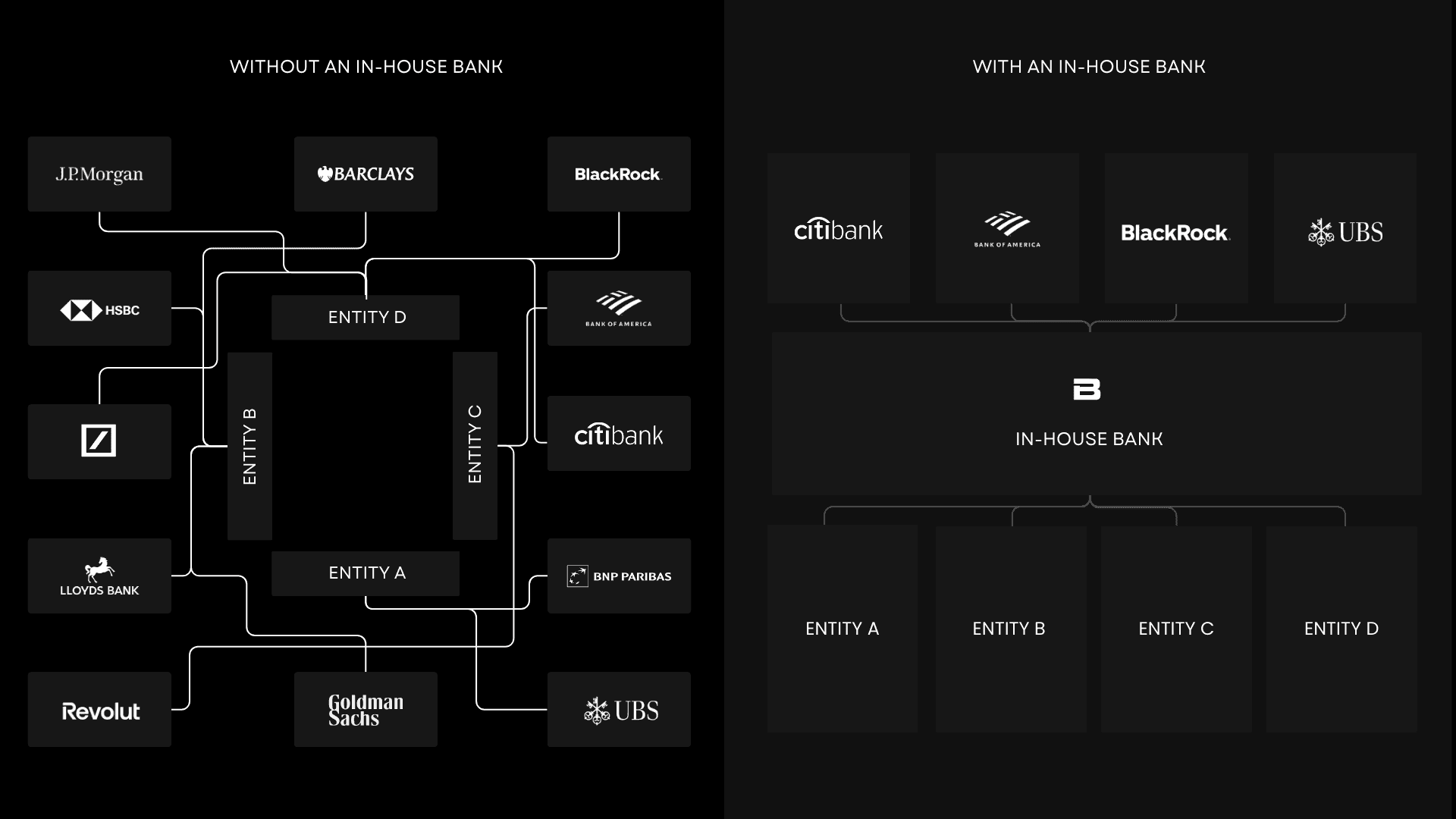
In-house banking is becoming increasingly common among multinational organisations looking to strengthen treasury and risk management, simplify operations, and reduce cost. As companies scale across regions, legal entities, and currencies, decentralised treasury models often result in fragmented cash positions, duplicated banking relationships, and suboptimal working capital deployment.
An in-house bank (IHB) addresses these challenges by centralising core treasury activities within a dedicated internal unit. In this article, we explain what an IHB is, how it works in practice, and the key building blocks required to operate one effectively.
What is an in-house bank?
An IHB is a central treasury function within a corporate group that acts as an internal financial counterparty to operating entities. Instead of each subsidiary interacting directly with external banks and markets, the IHB intermediates these activities on behalf of the group.
Typically, the IHB is responsible for onboarding and managing relationships with external banks and counterparties, executing funding, FX, and interest rate transactions, managing group liquidity, and overseeing financial risk. Subsidiaries transact with the IHB through internal accounts, while the IHB faces the external market at an aggregated, group-wide level.
Why set up an in-house bank?
- More efficient use of liquidity and capital: Surplus cash across subsidiaries can be pooled and redeployed, reducing idle balances, optimising capital allocation, and lowering reliance on external borrowing.
- Centralised risk management: Financial exposures are transferred to a single point, enabling consistent and professional management of FX, interest rate, and funding risks.
- Simplified banking landscape: Banking relationships and accounts can be consolidated, reducing operational complexity, transaction volumes, and fees.
- Stronger market positioning: By aggregating volumes, the group can approach banks and markets with greater scale, often securing better pricing, terms, and access than individual entities could achieve independently.
Centralizing risk management through the IHB
- Funding and liquidity risk are centralized as the IHB raises funding externally and distributes it internally to subsidiaries based on their needs.
- Interest rate risk can be managed by allowing business units to enter into intragroup interest rate arrangements with the IHB, which then hedges the aggregated exposure in the market.
- Foreign exchange risk follows a similar model, with subsidiaries transacting FX internally while the IHB manages the net exposure externally.
- Capital risk can be centralized by managing capital allocation through the IHB, improving visibility and control over group leverage and capital deployment.
2. Ledgers and internal accounts
A robust internal ledger and account structure is fundamental to operating an IHB. Internal accounts are used to record intragroup funding, FX, interest, payments, and collections in a consistent and auditable manner. These balances underpin intercompany accounting and ensure that all intragroup positions are transparent and reconcilable.
Without well-designed internal ledgers, it becomes difficult to support more advanced in-house bank capabilities such as netting, on-behalf-of payments, or internal pricing. As a result, the ledger architecture should be considered early in the design of any IHB model.
3. Funds transfer pricing
Funds transfer pricing (FTP) is a core component of an effective IHB. FTP allows the organisation to allocate funding costs, liquidity benefits, and risk transfer consistently across entities by applying internal pricing curves to intragroup balances and transactions.
Entities are charged or credited based on their internal liquidity position, creating transparency around the true cost or value of cash and incentivising better cash management behaviour. In parallel, interest rate risk can be transferred using intragroup interest arrangements priced on internal swap curves, enabling the IHB to manage the aggregated risk centrally.
Together, these mechanisms ensure that treasury outcomes are market-consistent, transparent, and aligned with the group's financial strategy.
4. On-behalf-of structures
In-house banking is often closely linked to on-behalf-of (OBO) structures, which further simplify cash flows and reduce the number of external bank accounts.
- Payments-on-behalf-of (POBO) allow the IHB to execute outbound payments on behalf of operating entities. Payments are made from the IHB’s external account and reflected internally by debiting the relevant entity’s internal account.
- Collections-on-behalf-of (COBO) operate in the opposite direction, with incoming funds received centrally and credited internally to the appropriate entity.
In both cases, the IHB acts as the central settlement entity, while intercompany positions are recorded through internal accounts.
5. Netting
Netting is another powerful capability enabled by an IHB. Intercompany payables and receivables can be offset within internal accounts, reducing the need for external cash movements. This lowers transaction volumes, reduces banking fees, and improves liquidity efficiency across the group.
6. Legal & tax considerations
The design of an IHB must take into account legal, regulatory, and tax considerations across all relevant jurisdictions. This includes transfer pricing requirements, withholding tax, regulatory licensing considerations, and the documentation of intragroup loan and funding agreements. Close collaboration with legal and tax advisors is essential to ensure the IHB structure is robust, compliant, and sustainable.
7. Next steps
Setting up an IHB is a strategic step towards a more centralised, scalable, and data-driven treasury model. With the right operating model, governance, and treasury technology in place, an IHB can materially improve liquidity management, risk control, and financial performance.
If you'd like to learn more about in-house banking or see how Bond supports IHB structures in practice, get in touch with the Bond team for a demo.
8. How Bond's AI removes admin grunt work from in-house banking
Bond embeds AI within the in-house bank to automate workflows, generate liquidity forecasts, and manage intragroup loans end-to-end - from structuring and documentation through to drawdown, repayment, and ongoing monitoring - to inform funding decisions and optimise group investment activity. Bond's flexible internal ledger transparently and audibly monitors intragroup balances, funding, FX, interest, and on-behalf-of flows, enabling AI to support optimal balance sheet management, risk mitigation, and return maximisation.
New York, NY 10010
United States
London, United Kingdom
W1J 6BD
Platform



Bond Financial Technologies Ltd is an appointed representative of Hurricane Capital UK Limited that is authorised and regulated by the Financial Conduct Authority. Bond Financial Technologies Ltd registered address is Second Floor, Berkeley Square House, London, United Kingdom, W1J 6BD. The information and the services referred to on our site are directed at professional clients, eligible counterparties and retail clients. However, retail clients may only rely on the information herein in relation to corporate finance business. If you have any doubts about your status you must not access our site. This website is for information purposes only. Nothing herein shall be construed (i) as an official confirmation and/or (ii) as advice or a recommendation. Please note that you are required to have read and accepted the terms of our Privacy Policy & Terms of Use before you are able to access our website.